I’m finally sitting down to hammer out my first post-pivot post after a brief pause caused by sewing-related distraction and my inability to decide how best to launch this next chapter of the life of DMS. When imagining how it’d take shape, I assumed that I’d begin by reaching back to my first completed project of 2025 and then methodically proceed from there, but my mind and fingers took me in a different direction. I’m thus starting with a proverbial bang and saving the less interesting stuff for later. I do, however, reserve the right to pull from my overstuffed vault of finished garments when I’m in a dry spell and have nothing better to bore you with.
Besides, I’m too obsessed with my latest make to delay writing about it, for my pizza shirt—a camicia italianissima, if you will—is my greatest accomplishment to date. Hands down. No contest. And yes, I count my PhD and surviving septic shock and just generally keeping myself alive in that.
As I’m sure I’ve mentioned in previous entries and will undoubtedly bring up time and time again, 2025 has been my year of sewing primarily with upcycled fabric. I’d like to say that my chief motivations for setting a “no, K, you can’t buy that gorgeous linen” rule are environmental stewardship and the dangers of fast fashion, but that would be a greenwashed exaggeration. While doing my part to prevent climate change is definitely right up there in my list of considerations, it’s a smidge behind my main drivers. These are, in truth, a little more selfish, practical, and pragmatic: fabric is expensive, I’m a very anxious individual, and I’m still a relative beginner. Sewing with secondhand textiles is therefore ideal in that it grants me the freedom to tackle new patterns and learn new skills without constantly worrying that I’ll end up with an unwearable shirt or pair of pants or whatever that cost $150 to make. By using, for example, a thrifted sheet instead of a store-bought cut of a gorgeous Liberty lawn, my only significant expenses are many hours of labour and horribly burnt fingers. (I could economize on the appendage-blistering, too, if I were more careful while pressing seams and had a better ironing station.) An additional benefit of my commitment to upcycling is that it brings more creativity to the process. My pizza shirt is a true testament to all that: an inspired original that leaves me with money in my wallet, burns on my pinkie, thumb, and index finger, and a garment like no other.
Why, you might ask, in a world full of more conventional linens, did I go for an Italian banquet on a 60″-by-80″ tablecloth? The real question is how I was so lucky to have it choose me. The answer comes down to the beauty of thrift-store shopping, which is a whole joy-sparking thing in itself. I used to find it onerous; now, it’s a thrill. I swear that scoring the perfect, inexpensive textile for a sewing project is an indescribable dopamine hit. A couple of bucks for a king-size sheet to transform into an interesting garment or three? Yes, please.
The best is when I spot something old and unique and the perfect amount of worn: still in decent condition but softened by many laundry cycles. That’s exactly what this fabric offered, and I knew it almost immediately. Indeed, as I rolled up to the linens section in my local thrift store a few weeks ago, my eyes were drawn to a folded-up item of a delightfully garish nature. I drew nearer, plucked it from the rack, examined it more closely, and confirmed that it was a tablecloth that was decently large and in okay-ish shape. It’d certainly been well-used (probably, based on the evidence of long-ago spilled coffee and tomato sauce here and there, by an Italian household), but it was salvageable. The pizza, pasta, cans of olive oil, and liberal splashing of other stereotypical Italian foodstuffs hid most of the tablecloth’s imperfections, and I could avoid the most obvious of these when laying out the pattern pieces.
$3.99 later, it was mine.
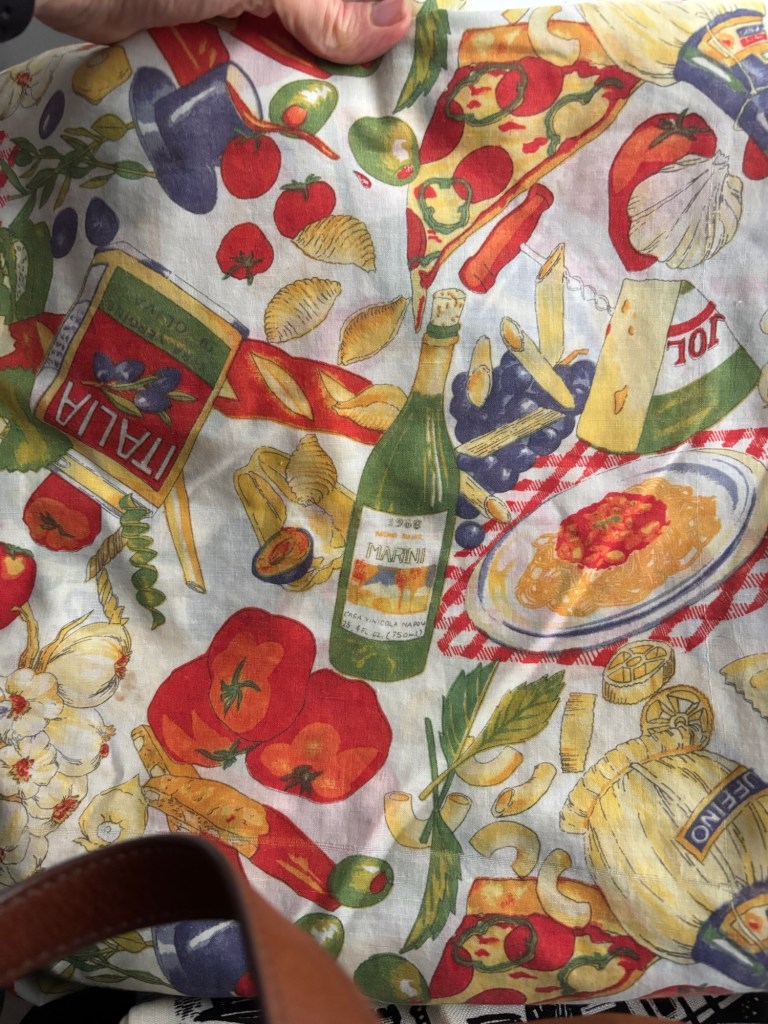
I swore to myself that I wouldn’t let it sit in my sewing closet too long. It’s easy to hoard thrifted material because it’s limited in quantity and singular in nature and so activates the scarcity mindset that explains why people (not me, to be clear) spend thousands of dollars on limited-edition Pogs and Beanie Babies to lock away in the attic. This tablecloth deserved a better fate than the one I’ve cast upon so many sheets and duvet covers and other linens I’m saving for exactly the right project. It deserved to keep living, to feel the summer breeze skim against it as I don it while zooming too fast through a park on my wheelchair, just as it once felt the culinary love literally poured on it by its previous owners.
Thankfully, I had something specific in mind: the Gilbert Top by Helen’s Closet, a BC-based designer I’m a huge fan of. I was psyched but also nervous to sew it; excited because it’s a gorgeous shirt, anxious because buttonholes are still a novelty to me. Until recently, in fact, I was so terrified of them that I avoided all buttonhole-requiring patterns. This closed off whole categories of garments and prevented me from spreading my sewing wings and attempting to take flight. I was envious of the impossibly impressive shirts and coats my seamstress friends and crafty influencers produced but felt myself an ostrich among hummingbirds: landbound, head in the sand. To be fair to myself, this fear didn’t come from nowhere but rather arose from a traumatic experience I had with my first machine, which had a four-step buttonhole that I never got right despite many, many tries and mangled plackets. After I purchased a machine with an automatic buttonhole function and was given a lesson on how to use it, it was like a switch was flipped. Exhilarated and cautiously optimistic that I wouldn’t mess them up, I made three simple button-up shirts in a row, and they were all minor successes. So when this magnificent pizza cloth entered my life, I was ready to take on a more complex buttoned garment, preparing to soar. Gilbert meet Gilberto: a match made in heaven.
The first step was, of course, cutting. As a result of both practice and the adaptive cutting solution my husband and I dreamed up earlier this year, I’m much better at it than I used to be. It nonetheless remains my least favourite part of sewing, and for good reason(s): it’s physically challenging for me, it’s boring, and I frequently make mistakes I kick myself for later. The stakes were especially high here because did I mention how obsessed I’d become with this tablecloth? Determined not to squander any of it, I spent a good thirty minutes figuring out how to best place the pieces to achieve the visual effect I was after. This was kind of tricky given the up-and-down arrangement of the various pizza slices, bottles of vino, etc. on the fabric itself, but I let myself be guided by intuition and plates of spaghetti. I then traced very slowly and methodically, inspected my work, and cut with extreme caution. Once finished, I took inventory; all looked good-ish. Not perfect, as I later discovered when I noticed a huge espresso stain smack-dab in the middle of one of the yoke pieces, but oh well.
It took me a few afternoons of sewing and several ripped seams to complete the top: not bad considering that it was my first camp shirt and involved several techniques I hadn’t tackled before. Helen’s instructions, which are always super clear and well-illustrated, made the process pretty painless. Fun, even? The ease with which my sewing machine produced the buttonholes certainly helped. The hardest part was selecting Gilbert-worthy buttons from my embarrassingly large collection of thrifted notions.
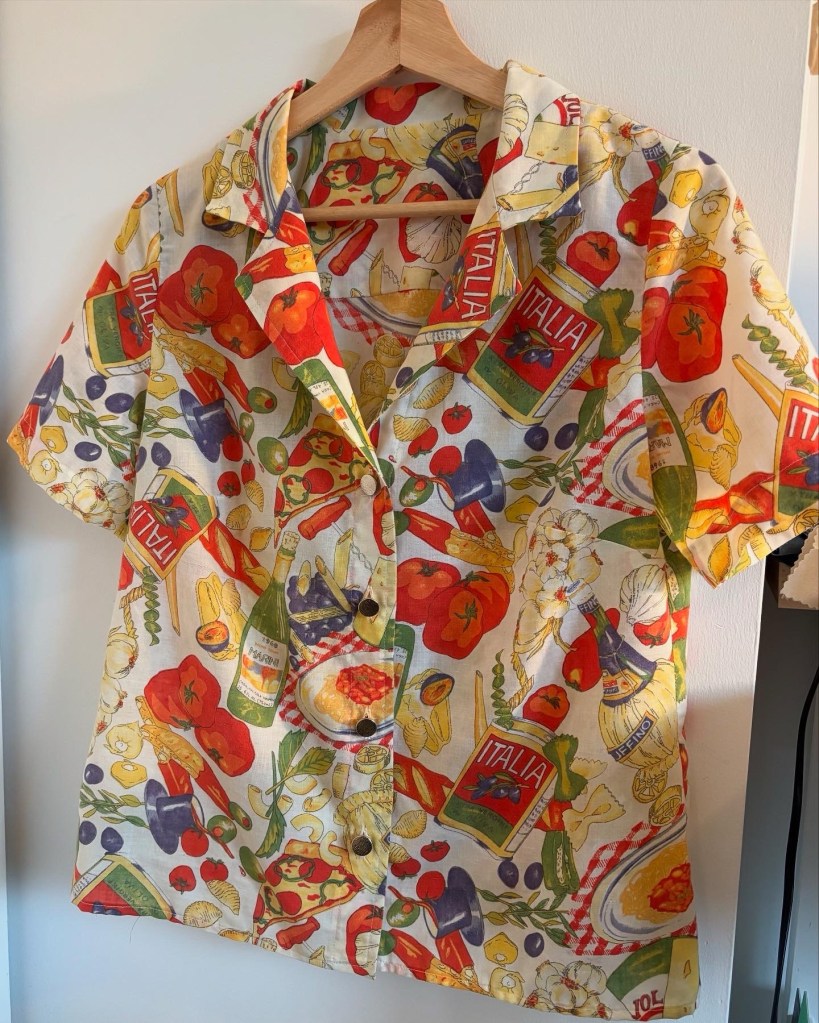
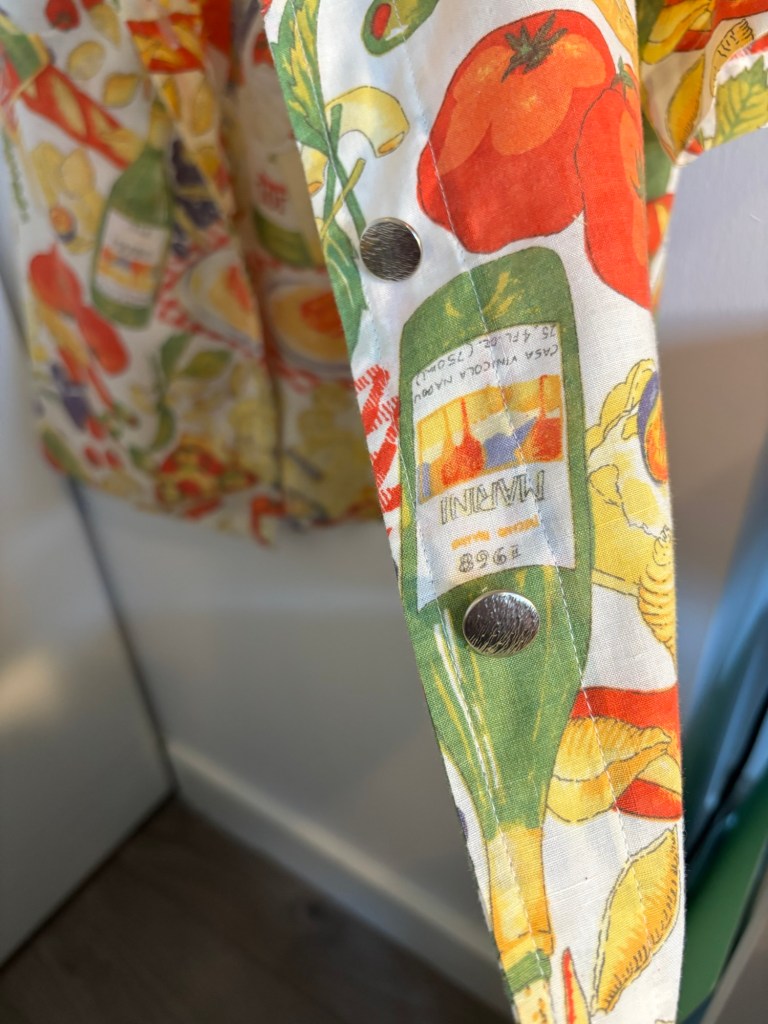
Now that I’m past the “sew endless, simple projects for near-instant gratification” phase and entering a new, more thoughtful one, I’ve been making a conscious effort to resist the very real temptation to rush, reminding myself that it’s about the process—about learning and expanding my skillset—as much as it is about the product. My dedication to working against my impatient nature has, in a roundabout way, made it more about the output since I find myself happier and more satisfied with each finished garment. As it turns out, a single article of clothing I feel confident and proud wearing is worth a hundred sloppy drawstring bags. My Gilberto is a case in point. I kinda love it, and my husband, who was skeptical when I informed him that I was making a pizza shirt, said that he’d be seen with me in public in it, which is incredibly high praise from a man with an annoyingly discerning eye.
If nothing more, I hope that I did that $3.99 and the Italian-Canadian nonna whose food stains now grace the shirt on my back rather than the linen on her table proud. I like to think I did.
 De Morbo Sacro: Life and/with Epilepsy