OK, here it is: the second instalment of a two-part series of posts about irons. Riveting stuff, right?
It’s exciting to me, anyway. I long ago stopped pretending that this blog is anything but a vanity project through which to indulge my whims and interests in a semi-anonymous format; as you might have gathered from my meandering prose and the eclectic subject matter I choose to write about, I’m not in this for the clicks. Ironing it is, then.
I might as well dive right into it and start back where I left off: with some big wrinkles to be ironed out.
As I mentioned last time, my Dritz has been nearing the end of its life for a while now. I nonetheless managed to ignore the fact that it had become a hazard to my personal safety and to my patience, which was rapidly wearing even thinner than its usual state (i.e., as translucent as a piece of tracing paper), for a remarkably long time. One afternoon, though, right after it’d tipped over and landed with its soleplate resting against my wrist—I have a giant burn mark to prove it—I looked at the Dritz, fantasizing about wrapping its dangerously frayed cord around its neck and strangling it. This was the quite literal tipping point at which I realized that it wasn’t just the integrity of my skin I had to worry about; my sanity was also on the line. I could no longer delay beginning the arduous task of conducting an exhaustive search for a replacement.
The timing was financially fortuitous. By selling the leftovers from abandoned hobbies of yore, I recently managed to free up space and stockpile some money earmarked for sewing supplies and tools. Most of it is for a serger (if you have any recommendations, send them my way!), but even after factoring in that major expense, I had a little cash to work with. Good thing, too, because sewing irons with the features I need/want—same thing—are $$$. I’m sure that there are seasoned sewists reading this and shaking their head, thinking, “I’ve used the same $5.00 Black and Decker for twenty-five years and been just fine.” Tell that to my hand scars, judgemental internet stranger.
Along with the hand spasms and contractions that complicate the iron issue for me, I suffer from a chronic case of analysis paralysis, a comorbidity of which is decision fatigue. Those conditions, with a hefty side of a lifelong guilt complex, often cause me to opt for the not-quite-right-but-marginally-cheaper option and regret it later when I, to use a completely random example, end up with hands covered in scars. I’m more solidly in an “invest in myself” phase, though, and I did have that guilt-alleviating sewing fund. Taking all this into account, I ultimately talked myself into purchasing my dream iron: an Oliso TG1600 Pro Plus.
In theory, it seemed ideal—a marvel in ironing technology simultaneously satisfying both my sewing and accessibility needs. I wouldn’t be forced to sacrifice one for the other. In this little slice of my life, I could have it all. The Oliso boasts a ceramic soleplate, the promise of extra steam action, etc., but its landmark feature, and the one that allowed me to justify shelling out $275 for it, is its auto-lift technology. Rather than resting on its heel like a typical iron, it always rests soleplate down. Could this be the end of my knocking a hot iron onto the floor, which I may or may not have done last Friday? When not in use, it sits elevated on plastic scorch guards to prevent fabric burns; when you hold its handle, which is equipped with “iTouch never-lift technology,” as per the description on the Oliso website, it automatically lowers to the fabric, and away you go. Even Rosey the Robot (of The Jetsons) couldn’t have imagined this. Gotta see it to believe it, which is why I watched approximately twenty YouTube videos of happy customers gleefully demoing their Oliso.
I ordered my very own TG1600 from an independent Canadian business elsewhere in Ontario because elbows up, Canada, and it was delivered a few days later. A stack of extremely wrinkled sheets sat waiting their reckoning; never had I been so excited to iron. Within an hour of opening the box, I’d set up my gorgeous turquoise appliance and worked through at least ten metres of fabric.
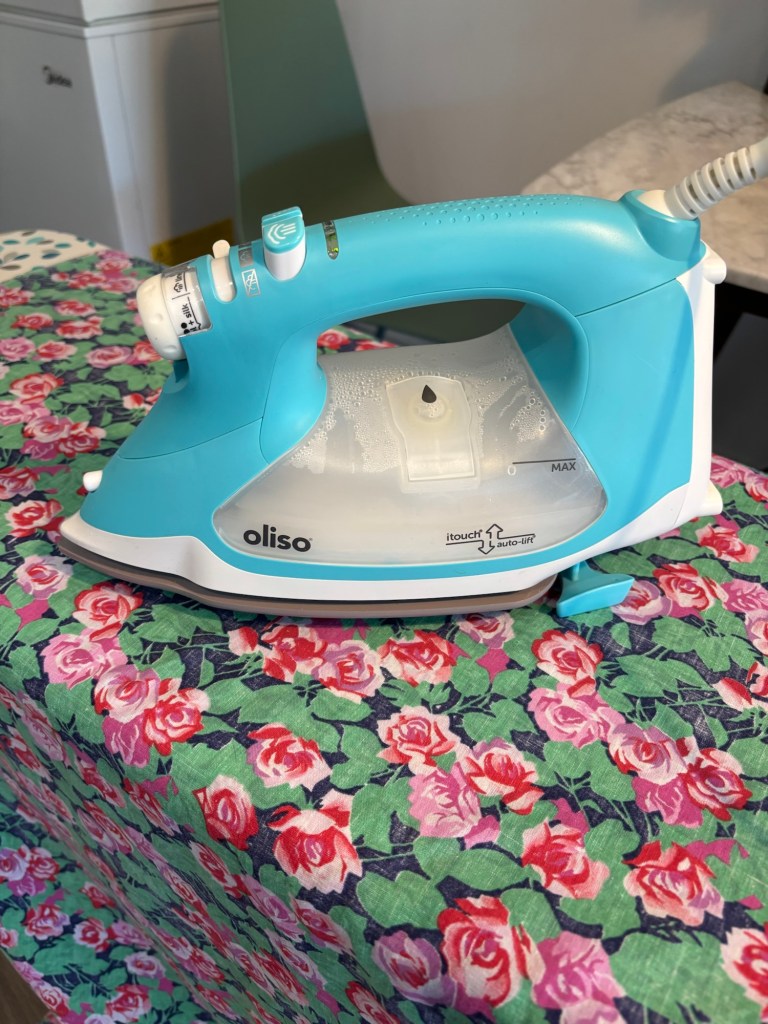
I was initially impressed. At first, muscle memory kept making me rest it on end. Once I got the hang of it, though, it took significantly less effort to operate than my old iron did. I’d been worried that the iTouch feature would prove more a gimmick than anything, but it was a small-appliance revelation. No burns! Less wrist strain! I was pleased with the Oliso’s overall effectiveness as an iron, too. Indeed, it glided across the king-size sheets like a hot Zamboni, leaving satisfyingly smooth fabric in its wake.
And now for the inevitable complaints.
The first isn’t the iron’s fault but rather my own. In short, it’s not the right tool for the job I bought it to do. I realized mid-sheet that it’s a bit heavy for finicky pressing, and the very feature that attracted me to it—again, the iTouch—is annoying for that kind of detailed work because the scorch guards extend with a little clicking noise each and every time the handle is released. It’s thus hard to position and reposition the Oliso without it performing a little groundhog-esque up and down. It’s also physically too big for the small ironing surface available to me in my sewing area, which I should’ve foreseen but somehow didn’t. No worries, though; my shortsightedness created a good excuse for me to spend more money to upgrade my table.
My second grievance is due to something I can safely blame on the Oliso and not on user error/stupidity, and I say that after extensive troubleshooting with a company rep: sometimes, not always, and seemingly at random, water gushes from the steam holes. Oliso eventually agreed to send a replacement, but this took way more time and effort than would’ve been ideal for a brand-new iron that was pretty pricey and should’ve worked from the get-go.
I’m holding off on taking them up on that for now, however, because—plot twist!—I’m prioritizing replacing my Oliso M3Pro project iron, the ProPlus’s baby sibling. My husband bought it for me as an anniversary gift (thanks, husband!), and it arrived while I was in the thick of sorting out the issue with ProPlus. I’d been really looking forward to having a functioning iron, but the M3Pro didn’t produce any steam, at all, plus the soleplate was chipped. Not a good look, Oliso.
In summary: would I recommend an Oliso ProPlus? Depending on your needs, patience, tolerance for leaking, and willingness to engage in an extensive back and forth with customer service … maybe? I’m on the fence, but I haven’t given up. I genuinely do wanna love it; it’s not too late for us to iron out the wrinkles. As for the M3Pro, I’ll be better able to give an informed opinion on that little cutie, which I’m even more invested in liking since it’ll be my everyday pressing tool, once I’ve had the chance to try an undamaged one. For now, however, back to my old Dritz. A few more burns won’t kill me.
 De Morbo Sacro: Life and/with Epilepsy