When I pivoted De Morbo Sacro in the sewing direction, my intention was to intersperse posts dedicated to my thrifting process amongst the project recaps. Lest you think that the lack of said entries is due to failure on the thrifting front, let me assure you that I’ve continued to steadily build a hoard of secondhand textiles stashed in my craft closet (and in Rubbermaid containers under the bed and in my storage locker …). The fact that I haven’t documented them or talked much about my thrifting strategies can be blamed squarely on how busy I’ve been this summer between working on various projects, exploring Ontario, starting a collection of Scouting and Guiding stamps (yup), researching and buying a serger (!!!), reading the Italian version of Wired magazine, etc. And, of course, thrifting, which has become a hobby and passion unto itself.
Ah, thrifting. What a joy; what a delight. At the risk of repeating myself—and I suspect I am, but I’m too lazy to review previous posts to confirm that—it’s only in the past year or so that I’ve had any interest whatsoever in stepping foot/rolling wheel in a Salvation Army or Goodwill. Now, it borders on obsession.
Luckily for me, my husband fully supports this pastime and indeed enthusiastically joins me in it. While I make a beeline for the linens, he heads straight to the clothes and proceeds to efficiently inspect them. The man has taste, a discerning eye, and the appreciation for a good deal, the combination of which makes him an excellent thrifter. He’s thus curated an incredible wardrobe of designer garments for a fraction of what he’d pay for cheaper stuff from the Gap or Uniqlo or wherever people buy new clothing nowadays. I, on the other hand, have curated a wardrobe of garments—some nicer, some sloppier, all one of a kind—that I’ve sewn from fabric purchased secondhand.
Less curated is the yet-to-be-sewn fabric occupying way too much of our apartment. I’m on it, though. As I slowly sort through it in a bid to get a better idea of what I have as to avoid filling gaps that aren’t there, I’ve been weeding down my collection by doing the painstaking, agonizing work of evaluating each and every piece of cloth and being as realistic as I can re whether or not I’ll actually use it. This is akin to conducting an archeological excavation in that the layers of textiles I uncover reflect where I was in my thrifting and sewing evolution at time of acquisition. The bottom-most stratum, dense with poly-cotton sheets, contains the synthetic fossils of my first thrifting-for-sewing days. I regret nothing but know better now, so into the “to donate” bag they go. The layers closer to the surface are more heterogeneous. The middle ones are a mix of good and “what was I thinking?!?”; the top is composed almost entirely of keepers.
This enlightening investigation suggests that through trial, error, and unwearable finished projects, I’ve learned what to target and what to leave behind. I now have a hard-and-fast “no poly-cotton sheets” rule to which I make no exceptions, no matter how delightful the print. In fact, more and more, I’m steering clear of any sheets that aren’t 100% cotton and vintage and in excellent condition. High-quality modern linens are OK if they’re in a natural fibre, have decent drape, and aren’t easily identifiable as being meant to cover a mattress rather than my body during daylight hours (i.e., no currently ubiquitous IKEA designs). Occasionally I’ll score a 100% linen duvet cover, the holy grail of textile thrifting. Sometimes I’ll find an amazing tablecloth perfect for transforming into a shirt. These are all permissible purchases, and I make them gladly.
What I’m really after these days, however, are metreages of garment fabric. If you know where to look and have the patience to wait, they’re there to be found. In my experience, it’s rare to stumble upon a single cut of a nice fabric; generally speaking, I’ll get several in the same store, material evidence in the literal sense of someone else’s abandoned hobby.
Earlier in my thrifting journey, before my husband and I started taking periodic day trips outside the Greater Toronto Area—trips that usually happen, by pure coincidence, I swear, to be to smaller cities or suburbs with a wealth of thrift stores—I was so excited every time “real fabric” (as opposed to sheet fabric) showed up in the only Salvation Army within walking distance of our place that I’d indiscriminately buy whatever it was without pausing to ask myself the critical question: “Would I wear something sewn from this?” Even worse, sometimes I’d ask the question but ignore the obvious answer. The day I found tens of cuts of extremely polyester-y prints straight from the 1970s, for example. They seemed too outrageous to pass up, and they were only $1.99 each! In retrospect, I should have documented them on my phone and moved on with my life. Instead, I have a box of over-the-top bold, dated-in-the-wrong-way fabric that will sit there, taking up space, for years before I convince myself to pay it forward to a novice thrifter as naive as I once was.
I’ll admit that the scarcity mindset that thrifting has a way of provoking still factors into my decision making from time to time. Part of the fun of buying secondhand is getting things you’re unlikely to find again, but that merit also makes it hard to resist an item that’s fine but not necessarily right; if you change your mind later, there’s a good chance it’ll be gone, and what a tragedy that would be. I tackle this thinking trap by reminding myself that there will always be more fabric and that too much now = too little space for potentially better textiles in the future. Furthermore, I don’t want to take everything and leave nothing for other shoppers. (My personal ethics of thrifting are the topic for another post. Suffice it to say here that I’ve developed a set of guidelines I try my best to follow.)
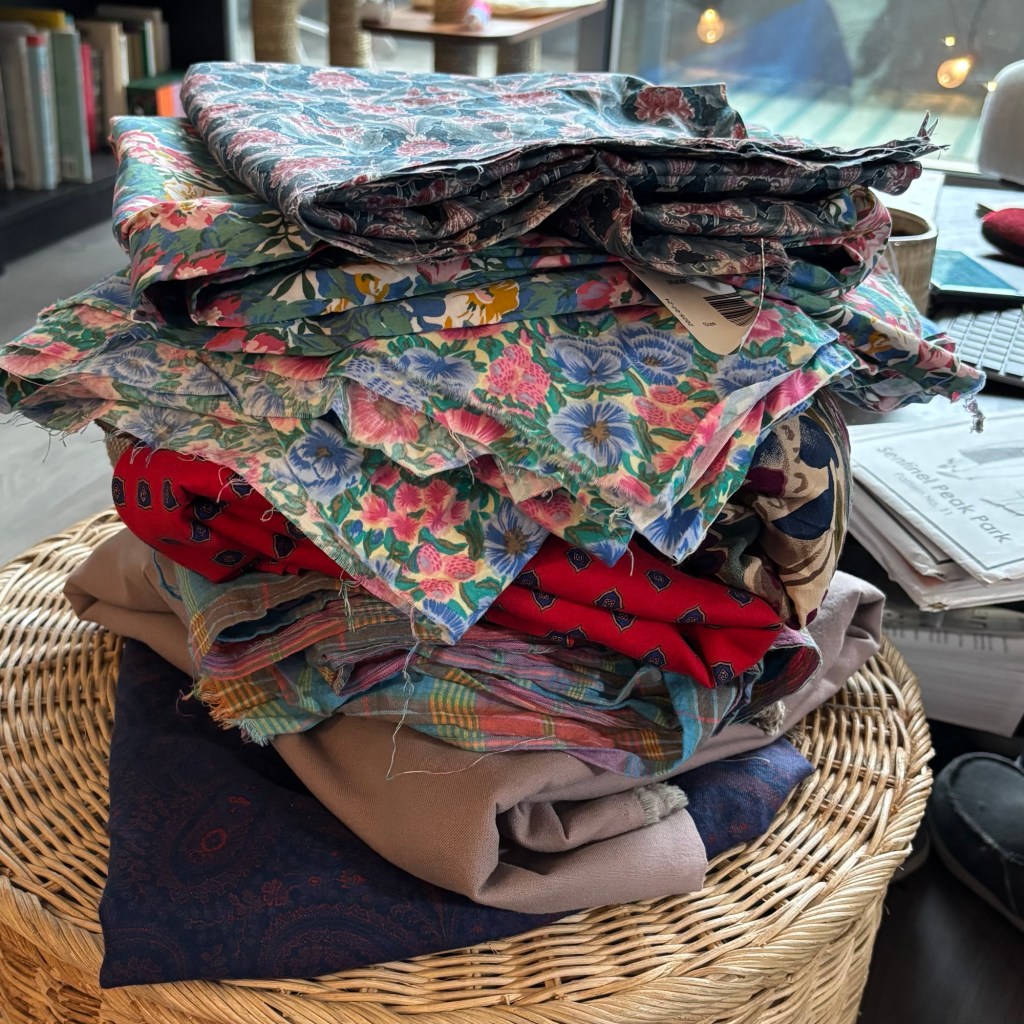
The time I’ve invested in honing my thrifting skills, along with my and my husband’s persistence, has resulted in some incredible finds, and my recent willingness to consistently say no to the borderline-OK stuff has meant that I feel good about adding to my stash when I hit these treasure troves. A few weekends ago was perhaps my best score to date: a total of seventeen metres of beautiful material, including some Liberty London Tana Lawn and a 3.75-yard cut of a cute vintage floral print with the tag still affixed from when it was originally purchased fifty-ish years ago, for a total of—wait for it!—$30. I’m not sure I’ll ever top that.
I will nonetheless keep looking, but I’m not in a rush. Goodness knows I have enough to work with.
 De Morbo Sacro: Life and/with Epilepsy