At the end of an especially frustrating day earlier this week, I found myself struggling to accept how little I’d accomplished. All afternoon, I’d flitted from one task to another, never able to spend more than fifteen minutes on any given thing before getting lost in the news or rolling to the kitchen for a snack. And sure, there’s much to get lost in these days—I really should deactivate all news alerts; they certainly don’t help my mental health—and yes, my meal plan is huge, so it’s almost always snacktime. This, however, was a whole other level of distraction.
I naturally chalked it all up to a character flaw or moral failure and proceeded to wallow for several more hours until, feeling all the feels as a wave of nausea hit, I realized that I could blame something other than myself for the fact that it was super hard for me to access the productive person that I’m sure exists somewhere deep within me. Indeed, if I were to draw a chart—and I did, following this epiphany—the line representing my energy and capacity to “work” would be the downward inverse of the one representing the increasing dose of an epilepsy medication I’m currently onboarding.
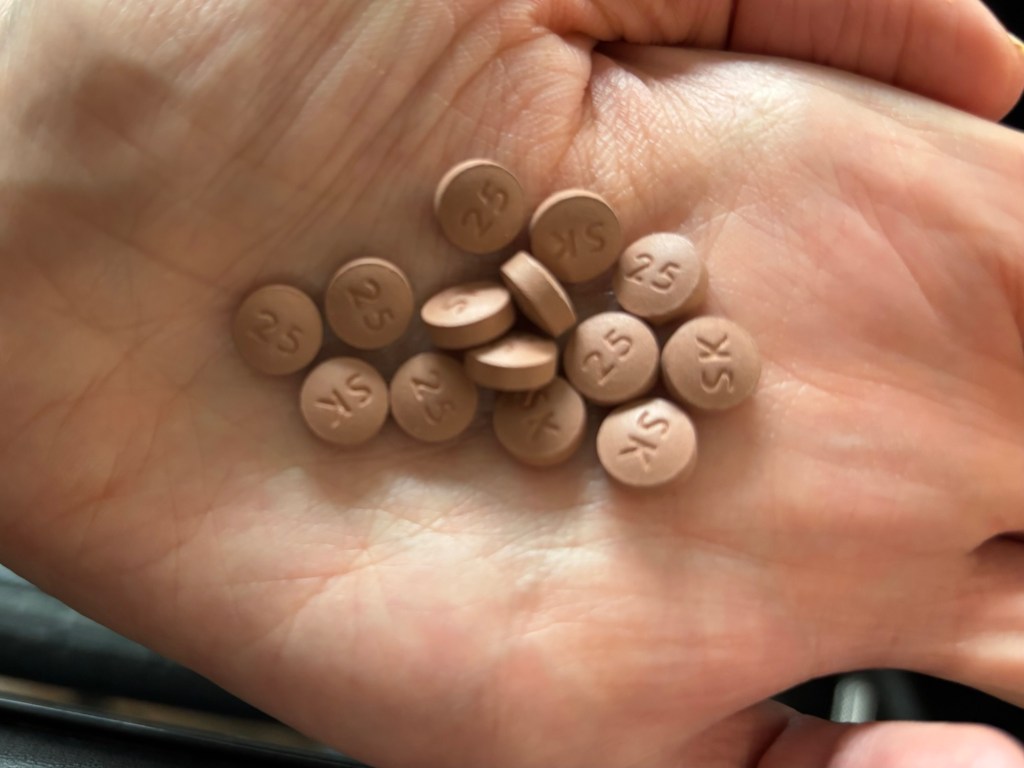
It would be unfair, though, to make this med the sole scapegoat of what’s in reality a much larger issue: my drug burden. It would be one thing if the new AED (Xcopri) were prescribed to replace the many others I take. Instead, it was added to an already-lengthy list comprising a lovely menu of drugs with cognitive and/or physical side effects that compound instead of cancelling each other out. Weird how that works.
Curious, I grabbed my blister pack and tallied ’em up. The grand total? Fourteen. Fourteen different prescriptions and not fourteen individual pills, no less.
This shouldn’t have been the surprise it somehow was. More evidence, I suppose, of my drugged-up mind’s extraordinary ability to gloss over what it doesn’t want to face. For those lucky folks who aren’t habituated to gobbling a veritable ratatouille of tablets and capsules morning, noon, and night, it might seem strange, or perhaps a little irresponsible, that in my perma–brain fog, I typically swallow the handful of pills conveniently presented to me in cute little plastic compartments without really thinking about what I’m ingesting. It’s only when I’m experiencing Dilantin-toxicity-magnitude side effects—or when I’m in the middle of a medication change, as I am now—that I consider the impact of the drug burden that epilepsy and OCD have so generously granted me. Ignorance is bliss or whatever.
Lacking the will to do anything but feel sorry for myself, I decided to linger a little longer on the farfetched idea that a cocktail of fourteen(!) medications might be holding me back from getting stuff done. Humouring myself, I turned to the almighty internet, reliably the source of an excess of information I’m not equipped to responsibly evaluate. My search offered food for thought in the form of a word I’d forgotten: polypharmacy, which, according to this legitimate-looking site that happened to be one of the first Google results, is “the regular use of 5 or more medications at the same time.” If five is considered a definition-worthy load, should there be a separate term for when the meds add up to almost three times that many? “Superpharmacy,” maybe? “Megapharmacy?” “Human drug store?” My husband’s insight on the matter was in equal parts validating and demoralizing: “It’s kind of crazy you can even talk.” True, I guess. It’s also true that in the not-so-distant past I couldn’t speak, so I guess muddled thinking’s an improvement. #silverlinings
Identifying a major cause of one of the problems that bothers me most is comforting in that it allows me to more easily give myself a smidgeon of grace rather than defaulting to “I’m a lazy McLazerton.” It doesn’t offer an easy solution, though. I’d love to simplify my drug regime, and I often push my doctors in that direction, but there’s not much to safely trim. Moreover, medication changes and withdrawals are challenging and potentially dangerous. I’ve learned this the hard way over and over and over, and I’m not eager to wake up in the ICU forced to learn it again. It’s hard to know when it’s worth the risk; while I yearn for a future in which I can focus for more than ten minutes at a stretch, I’ve fought for the relative stability I’ve achieved and am hesitant to put that on the line for a hypothetical. I’m all too aware of what I have to lose. It never seems like the right time.
It will be eventually, I hope. For now, I’ll fall back on the old “wait and see” and cross my contracted fingers that things settle into a more tolerable place when I reach a maintenance dose of Xcopri. In the meantime, I’ll continue being my drugstore’s VIP customer and my insurance company’s worst nightmare, inhaling my thrice-daily ratatouille, and feeling justified in spending much of the day listening to audiobooks and sewing.
 De Morbo Sacro: Life and/with Epilepsy