Please note that this is part one of what I swear will be a two-post series. I’m serious this time. Bear with me.
In the list of sewing-related activities I dislike, a very close second to cutting is ironing. For the purposes of this post, which isn’t a how-to but rather an opportunity for me to begin processing and complaining about my iron-induced trauma, I’ll lump it in with pressing, which is a distinct task that uses the same evil, evil tool and that I also hate but suspect I could learn to tolerate under better conditions.
I know I’m not alone in not loving ironing/pressing. It’s tedious and monotonous, and it can’t be avoided in garment sewing if your goal is a finished product that doesn’t look like you took a few randomly sized pieces of cloth, stitched them together, and called it a day. Of this double-pronged burden, the ironing comes first, before the dreaded cutting. As I’ve learned more than once, skipping this step isn’t a good idea, so suck it up and ignore the little voice in your head trying to convince you otherwise (I’m talking to myself here; you do you). The pressing, on the other hand, happens throughout the sewing process. Back and forth, from machine to ironing board—or, with my setup, to discoloured wool ironing mat on a rolling thing next to my sewing table. Ugh.
Unsurprisingly, accessibility concerns and limitations due to apartment living play into how I’m forced to approach this. As my mobility has improved, my ability to (safely) prep fabric has improved too, which is a little annoying because I can no longer blame sloppily ironed fabric on lack of arm function. God knows I still milk my finger contractures and spasms for all they’re worth, but those excuses don’t punch the same weight as “I can’t move my limbs” does.
When I have big ironing jobs to contend with—and we’re talking big since I often sew with sheets—my husband sets up the ironing board in our kitchen and takes out our cheapo iron. With the ironing board at its lowest height, I can awkwardly position myself sideways next to it and methodically do the job. It takes forever, and it’s exhausting, and I sometimes knock the iron over, but the end result is a reasonably OK, though never entirely wrinkle-free, piece of fabric. Good enough to work with, anyway, and I get some good audiobook-listening time in, not to mention an upper-body workout.
While relying on my husband to haul out the ironing board is a reasonable once-a-week ask, I sew, and thus press, on a daily basis and don’t want to wear his patience thin; gotta save that limited resource for the truly big stuff, such as driving me to thrift stores in the suburbs. And it wasn’t just concerns about how best to use my husband’s helping-me energy that motivated me to find a different configuration for pressing. There’s no space for a full-size ironing board in my bedroom, where my sewing machine resides, and it wouldn’t be practical for me to pile an in-progress project on my lap and wheel it from bedroom to kitchen to press each and every seam. I therefore needed something small enough to sit next to my sewing table, with wheels so that I could access the closet right behind it when necessary, and with a flat surface on which to work. The solution I settled on was an IKEA Råskog utility cart with the wooden lid designed to be a cutting board (I think?). A wool ironing mat fits perfectly on it, and I can stash patterns on the top shelf, under the board. On the other two shelves I keep frequently used notions and other bits and bobs, including interfacing, fabric scraps to practise on, tailor hams, very short pieces of elastic I can’t stand throwing out because I’m somehow emotionally attached to them, etc. For the pressing itself, I bought a Dritz travel iron to save space and because, to be perfectly honest, I didn’t have the knowledge or experience to know better.
For the most part, this handy cart has served me well. Little things about it irk me—the fact that it rolls, for example, and that it offers limited surface area. Virtues (didn’t I just write that I wanted something small and easily moved?) that are also annoyances. The real problem, however, has been the iron. It’s done the trick for simpler garments. Sure, I have to refill the water thing every five minutes, and sure, it randomly leaves marks every once in a while, but I simply keep a bottle of water handy and shrug off the marks when they appear, grateful, as ever, that I sew with thrifted fabric.
Harder to look past is its propensity to maim me. Indeed, something about its size and the way it emits steam, combined with my contractures and hand spasms, causes me to burn my fingers. Constantly. As in, I have three blistering burns on my fingers right now, and a graveyard of burn scars covers much of my left hand, which bears the brunt of the Dritz.
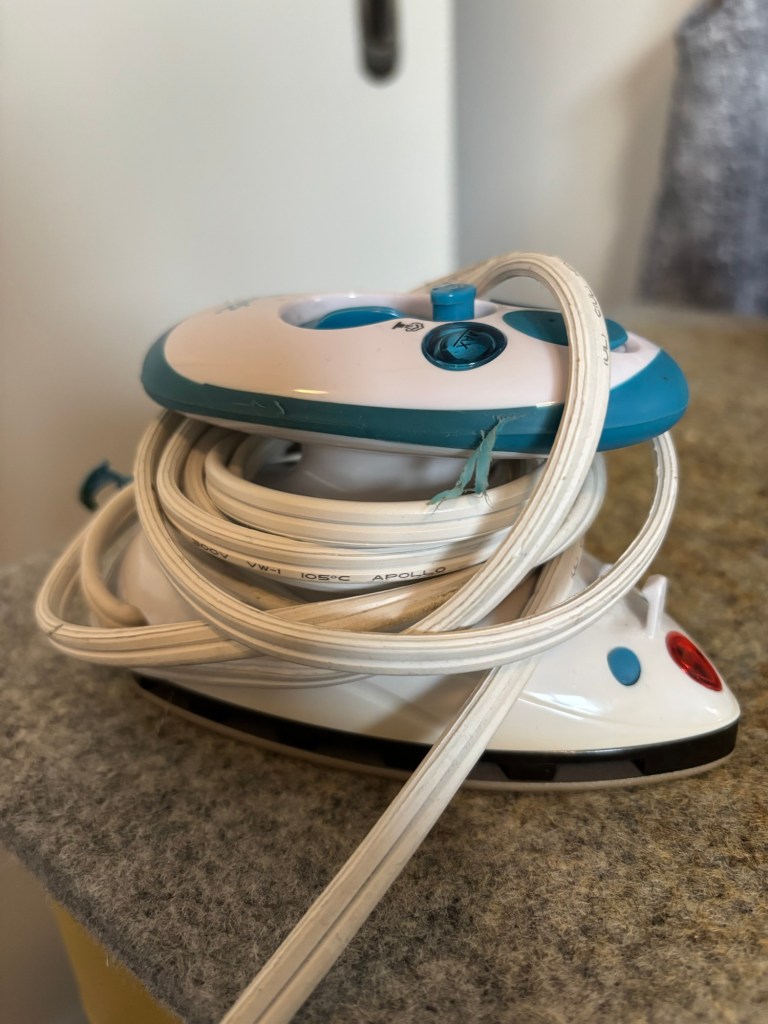
It was for health reasons, then, that I was forced to spend an obscene amount of money on a replacement. It arrived late last week. We’re in the getting-to-know-you phase, and I’m not sold but am keeping an open mind—maintaining cautious optimism that we can make this work.
I’ll end with the promise to continue next time with a small-appliance review for the ages. What a cliffhanger, eh?
 De Morbo Sacro: Life and/with Epilepsy