I recently realized that I now associate seasons with sewing projects more than with the weather (although the two are, of course, intrinsically linked). It takes time to plan and execute a seasonal wardrobe, so my brain is usually a month or two ahead: the official start of summer, for example, was when I sewed my first pair of linen pants, not when it was actually warm enough to wear them.
Indeed, I got going with the sundresses in March and was still working on a sleeveless, lightweight top at the beginning of August, which created the welcome illusion that the warm months stretched longer than they actually did. It was a few weeks ago that reality hit and I finally accepted—albeit reluctantly—that it was time to plan a fall wardrobe.
I’ve made some progress on that front, but it’s slow going. This is definitely a paradox-of-choice situation since indecisiveness + endless patterns = many, many hours spent making lists, crossing three things out, adding four more, doing one last Threadloop search and finding a jacket I absolutely gotta sew, “finalizing” my plan, and writing out said plan in elaborate detail and with great confidence. And then comes the most painful stage of the process: forcing myself to be realistic, which means eliminating half the projects I’ve become horribly attached to making. That’s where I currently am.
Whereas identifying patterns is no real problem, identifying what fabric to sew them with is significantly harder. With the goal of settling that open question, I began sorting through my sewing closet the Thursday morning before last.
Attempting to impose order on the unruly fabric that dwells there is always an overwhelming task, but my efforts are usually and almost immediately rewarded by the satisfaction and delight of unearthing material to pair with projects in my queue. Not this time, for, to my dismay, amidst the many stacks of textiles were few appropriate for fall/winter. This makes sense and shouldn’t have surprised me; a high percentage of my stash was originally in the form of a sheet or duvet cover, and besides the rareish flannel, which I typically find in plaid or Christmasy prints inappropriate for daywear, bedding skews heavily to the cotton and occasional linen side of things. I’d nonetheless assumed that I’d have no problem whatsoever shopping from my closet as I’d done for months and was thus left annoyed, frustrated, and very, very tempted to break my “no fabric purchased from anywhere except a thrift store in 2025” rule.
Being the masochist I am, I decided to distract myself by going to the lab to have overdue bloodwork done. The phlebotomist had to poke me five times. On the way home, I got drenched by a torrential downpour that hadn’t been in the forecast I’d checked moments earlier. I was not happy.
A few hours later, though, the skies cleared and I zipped to the thrift store for some retail therapy. The day was obviously cursed, so I wasn’t expecting much.
However—and what a “however” it was!—a yardage of beautiful fabric practically glowed like a supernatural treasure, beckoning me in its direction. Following its unspoken commands, I took it from the rack and examined it: definitely wool, a nice neutral colour, in fantastic condition, and long, perfect for a pair of cold-weather pants. The universe isn’t out to get me after all, I thought. The sewing goddesses want me to have nice things.
I kept looking. There was another. And another. And another. Six in total, all gorgeous, all wool, in varying shades and patterns, so many stacked in my lap that I had to call my husband so that he could come help me haul them all home.
Back at our apartment, I evaluated my purchases (a whopping $3.99 a piece). Three retained their original, time-worn price tag. $275, $350, $375, and that was in the dollars of decades ago. More than the value, though, it was the quality. I’m not sure I’d ever handled fabric so beautiful.
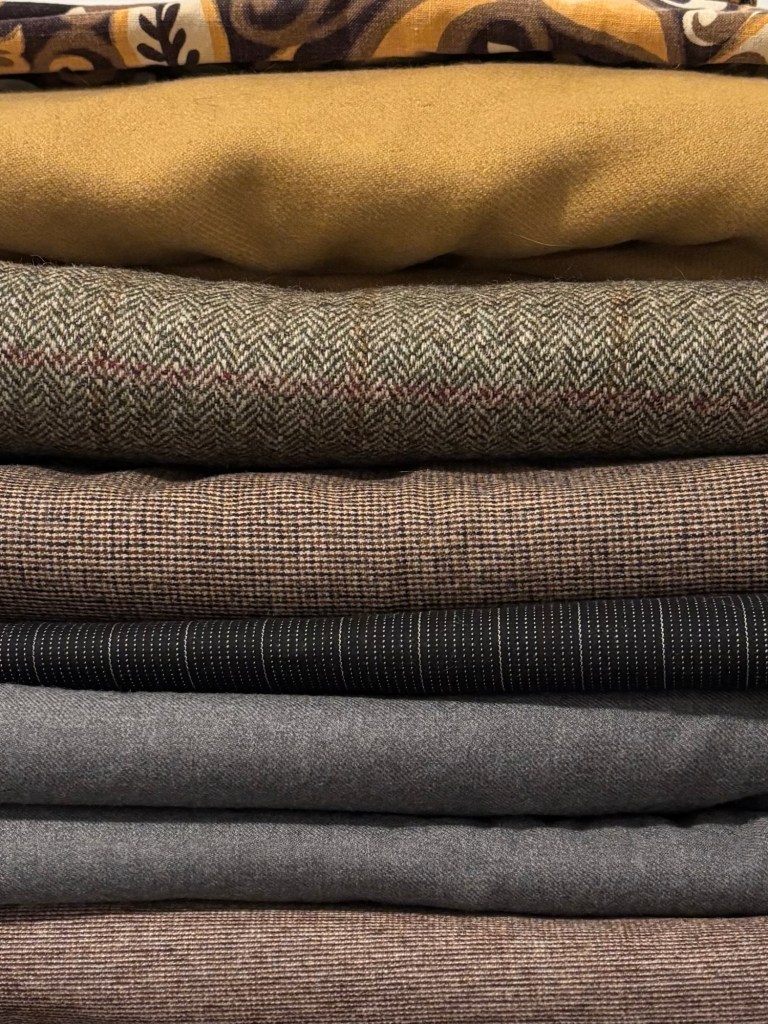
I next measured the pieces (all either two or three and a half yards) and cleared a special place for them, segregated from the sheets and duvet covers but near the amazing metreages that comprised the incredible second-hand haul I’d thought would forever be the pinnacle of my career as a textile thrifter. For once in my life, I’m glad I was wrong but very glad I found them; you’re special too, Liberty London prints.
The timing of this score was absolutely fortuitous, and I now have more than enough fabric to work with—no firsthand orders required. Of course, I now face another challenge: convincing myself that it’s OK to use it. Before I take the plunge and pull out my rotary cutter and shears, I’ll wait a beat, continue planning, and periodically admire, and fondle, the various cuts. Thrifting is the best. I’m a lucky woman.
 De Morbo Sacro: Life and/with Epilepsy